
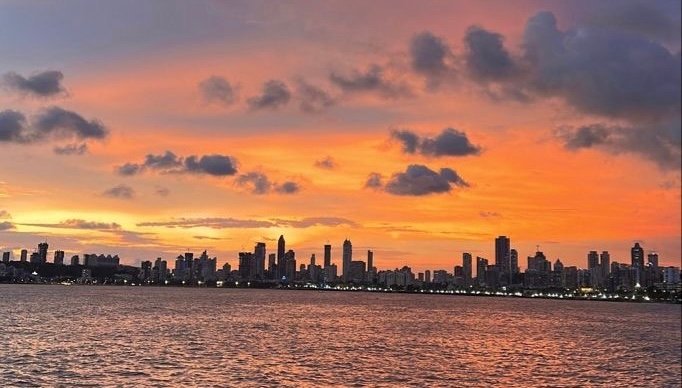
The new dawn always brings new opportunities. Still, in Bombay, every hour, every minute that passes brings a new beginning. Every second that passes by is not just a reminder of what one has lost or what they could’ve gained but a sense of fascination that the second that passed was in this city, which makes it ultimately gold.
Ever seen a person talk about how they yearn to come to Bombay? Or perhaps the correct question is: who doesn’t yearn to go to Bombay? Making it rhetorical just adds more value to what I’m trying to explain in this essay.
For years, this city has been the golden city of India giving it the charm and freedom that Indians yearn for. And it has succeeded in attracting people from all over the country and yes, possibly all over the world.
But what lies beneath the charm and glitter of this ever-awake city? A feeling, a sentiment, a phenomenon—something so sensational, yet so privately coherent to a human, that only they can feel and express it.
Something that can never be found in a guidebook or even in the skyline because it resides closer to you than the veins in your artery.
It’s a feeling that arrives quietly, slipping into your mind while the first throw of wind hits your face as you stand on the edge of a local train door. Or when your vada or samosa pav tastes like resilience and rebellion after getting rejected in your first interview. Or maybe when you’re walking home past midnight and feel oddly safe.
These emotions don’t announce themselves they settle in.
Bombay is like those homes that never turn off their porch lights. The warm tone of the light above the main doorframe is what this city feels like, a place that is always yours. You can always come back to it and feel secure and free.
Bombay is a home where the kids and parents laugh at dinner, where they all make jokes at each other and nobody takes it seriously because they value each other so much.
Bombay is that city which feels like a slap from your father that changes your life and awakens your dying dreams.
Bombay is that city that makes you wonder if your mom could’ve lived a great life had she come here like you did.
Bombay is that place where you taste employment in every pebble of the street, along with cheap food to satiate your griefs.
These intense and sensual emotions define what I call The Bombay Period.
It’s not loud and it doesn’t knock, it seeps in like dew on your skin: moisturising, soft, but certain.
The Bombay Period isn’t always marked by big events, but by the moments that make light, soft feelings major in your life.
Sometimes it’s the moment you learn how to travel in a Kalyan or Virar fast during evening rush hour.
Or when there’s a power cut and you’re sitting outside with all the kids, uncles, and aunties in the chawl playing carrom or ludo.
Sometimes it’s the exact second that makes you realise you’re not just surviving, you belong here.
And this story is your Bombay Period.
Bombay has been the central idea of my life ever since I realised that Bombay was an emotion, and Mumbai was an overpopulated city.
In the midst of preparing for unit test exams, I found my hand in my father’s as he took me to outrageous places around the city, where my still-emerging personality, a mind not yet radical but restless, saw so many people with jobs and businesses that amazed me.
It made me realise that money was something that could easily be earned, it wasn’t sacred, just possible in every corner of the street.
And I stand by that even ten years later, in my young twenties, where people might say my frontal lobe is still developing.
To them, my response would be: I have tasted life because I have tried it.
Understanding comes from experience, not from just blowing candles every year on your birthday.
Capitalism was never something I understood, especially when I would see the ample number of jewelry stores in Zaveri Bazaar or lights and decoration shops in Lohar Chawl, all selling the same things, and yet they’ve been doing it every day, again and again, since before I or even my parents were born and still never shutting down their businesses.
In theory, capitalism says only the best survive.
That competition kills the slowest. That there can only be one winner.
But Bombay never believed in elimination. It believes in coexistence through chaos.
In a place so broad in opportunities yet small in size, every person lives to survive in the crevices of the economy.
Like the water that flows in Bombay rains, but imagine with better drainage, that’s what people are, as they spill into every crevice of the economy.
In Bombay, a hundred shops may sell the same thing, side by side, and yet none of them shut down because people buy from all of them. That’s the marvel of it.
Just like the Bombay stories.
A million writers could come up and make Bombay their muse, and nobody will ever get bored of it.
I found defining what the Bombay Period is to be the simplest part of my Bombay Girl Chronicles journey.
The feeling is mutual, yet so private to each person that just a hint of the story makes them understand what the Bombay Period is.
It’s not like the Jacobean or the Victorian period in English literature, it’s the period that starts when your mind ticks and you know what you’re in for with the city.
The Bombay Period doesn’t start with a pen or a publication, it begins with the switch flipping during the auto ride, when the meter jumps before the rickshaw even starts.
It is the period that stays with you, whether you’re in Bombay or you’ve left it.
Like a breeze curling your hair in the most tangled way possible, only to end up looking like the best hairstyle of your week.
It starts the moment you realise the city isn’t going to wait for you.
It won’t explain itself.
But if you can keep up, even barely, it’ll teach you everything.
This period doesn’t follow centuries or crowns.
It follows gut instinct, crowded trains, quick idli-wada breakfasts, and that aching clarity that no one’s coming to rescue you but somehow you’ll be okay.
Your Bombay Period begins when the city doesn’t feel new anymore. It feels like you.
It’s the moment you realise you’ve memorised BEST bus routes and chosen a rock that you’ll always sit on by your favourite beach.
When your ambition becomes less of a dream and more of a daily routine.
And no textbook will ever talk about it but you’ll carry it like your first heartbreak, your first unpaid internship, your first 6:45 am local.
Being a Bombay kid is different from a “normal” childhood, especially with the craze of finding yourself in this particularly crazy city just to make sure others find your uniqueness too.
My story is that I saw Lohar Chawl, Crawford, and Manish Market before my feet could touch Marine Drive or Carter Road and this shaped me in ways I never imagined.
This is my Bombay Period.
This is what I’ve felt in this city, something I will never forget or find in any other place in the world.
This is the city where a young girl travelled to “obnoxious” places and still felt entirely secure and comfortable.
Maybe Bombay was the first man who didn’t stare.
Maybe it was the only one.
Bombay gave my rough sketch a character enhancement.
It made my draft look like a Salvador Dalí painting.
It confuses me, yes, again and again but that’s the thing about this city: it doesn’t give you clarity on the first look.
Like a painting that changes perception depending on where you’re standing or who you are that day.
I’ll wake up tomorrow and try to understand it again.
I’ll try to find myself again.
Because that’s what the Bombay Period is—
A loop of discovery, A little chaos, A little creation, And the madness of the humidity.